Why the Greatest Breakthrough in Cardiometabolic Medicine Is Being Dropped by Insurance

Updated: Sep 2
For decades, chronic disease management has been largely reactive: we waited for dysfunction to cross defined thresholds (i.e. a cholesterol over 230, an HbA1c above 6.5%, or a stroke/heart attack) before deploying intensive pharmacological therapies.
The rapid evolution of therapies which include medications such as Semaglutide (Ozempic), Tirzepatide (Zepbound), and the soon-to-come Retatrutide are reshaping that reactive paradigm. However, just as the clinical evidence begins to rapidly compound, an economic wall is being built. This is particularly being felt right now, as companies begin their open enrollment cycles and benefit design updates. We have begun to see that employer-sponsored plans and commercial insurers are actively scaling back, restricting, or eliminating coverage for these therapies rather then expanding it.
To understand why this is happening, we have to examine the divide between multi-decade preventative medicine and short-term healthcare financing.
The Mountain of Evidence: More Than a Number on a Scale
When semaglutide and tirzepatide first gained mainstream attention, the headlines focused exclusively on body weight. But the clinical literature over the last few years paints a different picture: these medications are whole-body cardiometabolic and anti-inflammatory powerhouses.
In the landmark SELECT trial, semaglutide reduced the risk of major adverse cardiovascular events (MACE), defined as nonfatal myocardial infarction, stroke, or cardiovascular death, by 20% in non-diabetic patients with preexisting cardiovascular disease who were overweight/obese. Crucially, cardiovascular benefits began appearing early, before maximal weight loss was even achieved, suggesting direct vascular and anti-inflammatory mechanisms.
The FLOW trial demonstrated a 24% reduction in primary kidney disease events and cardiovascular mortality in patients with chronic kidney disease (CKD) and type 2 diabetes.
A third study showed that tirzepatide and retatrutide are the first effective treatments we have ever had for fatty liver disease, also known as metabolic dysfunction-associated steatohepatitis (MASH). This is particularly significant because MASH is one of the fastest-growing causes of liver failure and liver transplantation.
Finally, across multiple clinical evaluations, GLP therapies have shown significant, sustained reductions in systemic inflammatory markers such as hs-CRP. We are also seeing significant data emerging around improvements in obstructive sleep apnea (OSA), osteoarthritis-related joint burden, and even investigations into neurodegenerative conditions like Alzheimer’s disease.
Who Should Be Treated, and When?
This mountain of evidence naturally pushes clinical medicine toward a proactive question: Why wait?
If a 35-year-old patient presents with abnormal visceral adiposity, subclinical insulin resistance, elevated ApoB, and baseline systemic inflammation, but has not yet developed full-blown type 2 diabetes or a 30+ BMI, traditional guidelines often advise watchful waiting and lifestyle changes.
Yet, from a longevity and preventative health perspective, intervening earlier could prevent the microvascular and endothelial damage that compounds over decades. Halting visceral fat accumulation and hepatic steatosis at age 35 fundamentally alters an individual’s health trajectory at age 65.
However, broadening the indications to include pre-disease states immediately runs into the cold reality of healthcare costs and economics.
The Employer Dilemma: When Prevention Clashes with the Balance Sheet
Recent employer benefit surveys reveal a stark trend: despite surging employee interest, the majority of employers are not expanding coverage for anti-obesity and metabolic therapies, and a growing percentage are implementing aggressive utilization management, prior authorization hurdles, or outright formulary exclusions.
According to data tracked by the International Foundation of Employee Benefit Plans (IFEBP) and the Business Group on Health, almost all employer health plans cover GLP-1s for type 2 diabetes, but only around one-third cover them for weight loss and broader metabolic indications.
This is not necessarily because CFOs and plan administrators dispute the medical science; it is because the economic design of employer-sponsored healthcare is incompatible with long-term preventative therapeutics.
The list prices of many of these drugs sits between $900 and $1,300 per month per member. This has caused pharmacy benefit costs to surge rapidly and they now account for double-digit percentages of total claims.
The Time Horizon Problem: An Incentive Mismatch
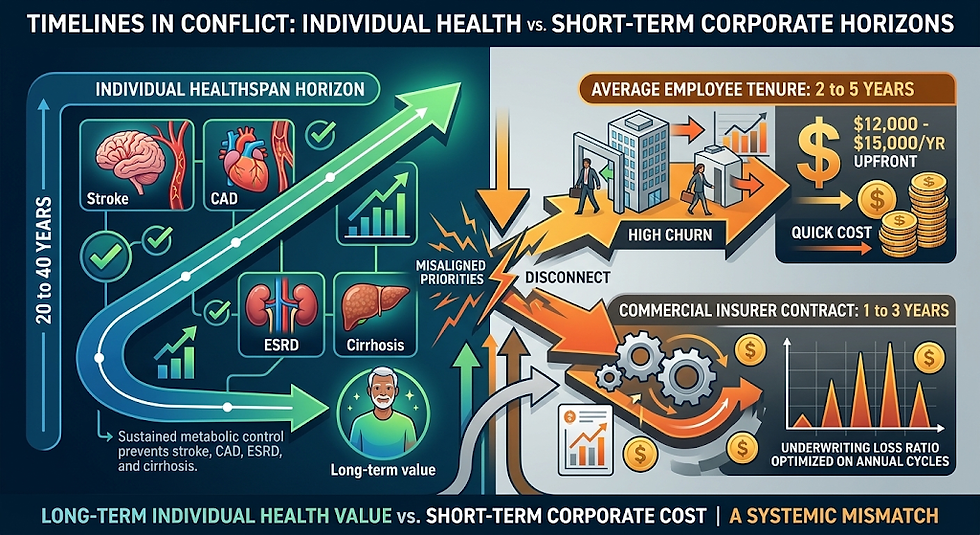
The core friction comes down to time horizons:
The Tenure Mismatch
The average American worker changes jobs every 2.8 to 4.2 years. If Employer A invests $36,000 over three years to provide high-tier therapy to a 42-year-old employee, that employee’s metabolic health will significantly improve. However, the multi-hundred-thousand-dollar catastrophic claims prevented (such as a coronary bypass at age 58, a stroke at age 63, or hemodialysis at age 68) will never show up on Employer A’s balance sheet.
Instead, the financial return on Employer A's investment is captured by:
Employer B, C, or D; or
Medicare decades later.
The Commercial Payer Calculus
Commercial health insurers, particularly in fully insured lines, operate on annual loss ratios and short-term actuarial models. A medication that incurs substantial recurring costs every month today, but yields savings beyond a 5-to-10-year underwriting window, presents a net financial drain under current payment structures.
In economic terms, this is a classic positive externality problem: the entity bearing the upfront cost cannot capture the downstream economic return.
The Long-Term Consequences of Short-Term Rationing
When coverage is pulled or restricted to only end-stage disease criteria, several unintended consequences emerge:
Widening Healthcare Inequity: Those with disposable income will continue to pay out-of-pocket for brand-name therapeutics or navigate direct-to-consumer digital clinics, while individuals reliant strictly on standard commercial plans are left without access.
Rise of Unregulated Sourcing: High retail costs drive patients toward unverified compounded alternatives, gray-market peptide suppliers, or self-dosing protocols without appropriate clinical supervision, raising patient safety risks.
The Downstream Medicare Tsunami: By restricting early, disease-modifying metabolic intervention during prime working years, the commercial system essentially kicks the burden of chronic cardiovascular, renal, and hepatic disease directly down the road to Medicare and taxpayer-funded programs.
Where Do We Go From Here?
Resolving this deadlock requires moving beyond binary arguments of "employers should just pay for it" versus "cut the benefit to save the budget." We need structural innovation in how long-term therapeutics are valued and financed:
Value-Based and Outcomes-Driven Pricing: Pharmaceutical manufacturers and payers must move toward risk-sharing models where reimbursement is tied to sustained clinical endpoints, such as maintained reduction in HbA1c, visceral fat metrics, and blood pressure control.
Multi-Year Portable Health Savings Accounts and Credits: Creating mechanisms where preventative health investments follow the employee, or where future payers (including Medicare) provide tax credits or offsets to employers that demonstrably improve baseline employee metabolic markers.
Aggressive Upstream Tiering: Instead of blanket exclusions, utilizing precise biomarker-based stratification (visceral fat imaging, ApoB, hs-CRP, etc) rather than crude BMI cutoffs to target therapies to the highest-risk cohorts where ROI manifests fastest.
Competitive Market Maturation: As oral small-molecule GLP-1s (such as orforglipron) and next-generation multi-agonists clear Phase 3 pipelines, manufacturing scaling and therapeutic competition must bring net prices closer to traditional chronic disease maintenance medications.
The Bottom Line
GLP therapies have proven that metabolic disease is neither a personal moral failing nor an untreatable inevitability. The science of longevity and metabolic optimization has made a massive leap forward.
Now, the burden is on our healthcare system to evolve its financing models to match. If we continue using a 1970s transactional insurance model to evaluate 2030s preventative technology, we will fail to deliver on the greatest public health opportunity of our generation.


Comments